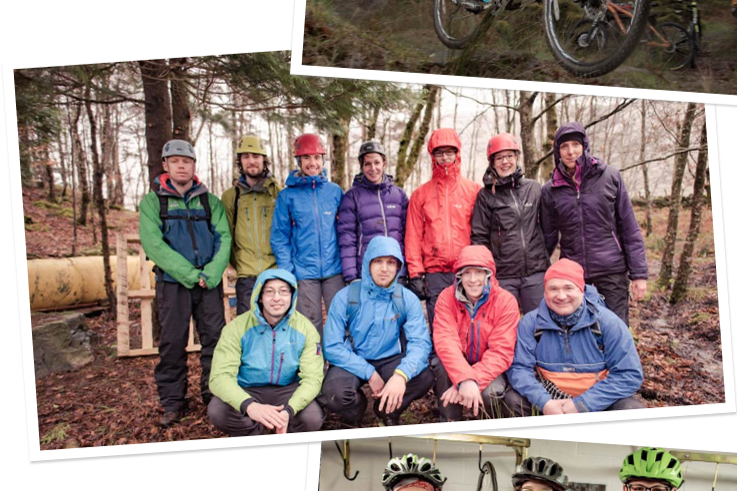
Graham Thompson has been working with Mark Taylor from Leeds Uni - one of Dave Brook's team there: Leeds Uni have always had the most reliable test results & have worked outside the lab to balance testings with real experiences (I would imagine that has been Graham's role here)
The pair are presenting their findings at the forthcoming www.innovtaion-for-extremes.org conference - which is open for all to attend the last Wednesday of September at Lancaster Uni
If Jon does not make it there I am sure that others will question the pair about this...
|
 |
 Unfortunately, I won't be there as I'd have liked to question them about this. I've done my own tests with different footwear on each foot and I find that the foot with the membrane lined footwear on is hotter and sweatier than the one without membrane lined footwear in temperatures above 10C. The effect is there at lower temperatures but not as noticeable, in sub zero temperatures it's negligible. It's also more noticeable in lighter footwear with mesh panels. The thicker the footwear, with more foam, heavier leather, broad rands etc, the less noticeable the effect of the membrane. Of course you can plaster a leather boot without a membrane with wax and render it almost non-breathable and very hot.
|
 |
 Are these tests carried out when you would actually want a waterproof boot on though? For example walking through marshland where a waterproof boot may cause you to sweat a little, but will keep bog water out, or when its raining hard, and your waterproof boot stays drier but a non waterproof one will get soaked through, but lets your foot breathe! What’s the point in that once it’s already soaked?
The argument so far leans towards the side of wearing a non-membrane boot, but for in the conditions that you should need to wear one of these type of boot surely it will keep your feet dryer then without a membrane boot.
Can someone please clarify this as its left me quite confused really.
|
 |
 My tests have involved a whole mixture of conditions from wet snow, bogs and rain to dry sunny weather. In bogs and rain waterproof boots will keep water out, unless or until it gets in over the top, but I find that my feet get damp from sweat. In temperatures above around 5C I find breathable boots/shoes that are wet more comfortable than waterproof ones. My concern is with comfort rather than keeping rain/bog water out. In May I walked for 2 weeks across the Highlands on the TGO Challenge. I wore breathable, non-waterproof shoes which were frequently wet as there were many bogs and it rained frequently. However my feet felt fine throughout and the shoes dried fast when walking on dry ground in dry weather. Membrane lined boots and shoes take ages to dry once wet. In winter conditions keeping your feet dry is important of course and membranes have a part to play then, especially as gaiters are usually worn then too so water is less likely to enter at the ankle.
|
 |
 Ah thanks Chris, I'm a lot clerare on the matter now. So for all year round wlaking in Snowdonia (what I do) would you reccomend a membrane or not? I'm after soem shoes, as all I have now are some approach shoes which jsut arent stiff enough with a pack on my back, I need some boots and was thinking going for membrane as I always seem to come across a bog no matter what route, and it always rains too. What would you reccomend? Usually its a case of walkign all day, one patch of bog, soked feet and then uncomfortable for the rest of the way. Do any shoes come with e-vent rather then gore? That would be a bit more breathable I suppose? Or what about a paramo shoe?
|
 |
 If I was going for one pair of boots for year round walking in Snowdonia I'd be old-fashioned and go for traditional leather boots and keep them well waxed most of the time, and less waxed for more breathability in dry warm periods. That would be the best compromise I think. However I would much rather have winter boots and three season shoes, the former perhaps having a membrane.
There are shoes and light boots with eVENT membranes. I don't find them any more breathable or any cooler than ones with Gore-Tex XCR membranes. Paramo has not made a shoe .... yet! At the recent Friedrichshafen Outdoor Show I did see some interesting looking soft shell shoes. I've no idea how they will perform of course.
|
 |
 I have some of the Salomon Soft Shell shoes, I think they're pretty decent for dry weather use, though not ideal when it's proper wet :-)
Sort of a halfway house between totally porous fabric running shoes and more water-resistant footwear and quite breathable. Unfortunately it's not hot enough to say much about that side of things.
Oh, and what no-one's mentioned, of course, is that around a third of the surface area of the foot is on the sole. I wonder that the implications of that are...
|
 |
 Regardless of the scientific results, it's all about individual perception. And your socks.
Chris Townsend is a roaster, all things for him are hot, from lined footwear to the thinnest merino boxers. He speaks the truth from what he finds, which will be wildly different from lab results. If I use an identical item of kit to Chris I will be happy and comfy in the same conditions, falling off the other end of the lab drafted scale.
It's like sleeping bag ratings, essentially pointless until you learn how much down will keep you and only you warm in what conditions you heading to.
This is also pointless what I'm saying, but it means that I'm raising a metaphorical eyebrow regarding the situation and would like to see what happens next.
|
 |
 PTC is right that individual perception is very important and so are socks.
The problem is for novices who don't know how hot they run, how much down will keep them warm, what sort of footwear is best for them.
I'm not as much of a roaster as some people. I do wear Paramo!
Jon, the sole is interesting. I was in the Rockies last winter and found that walking round a town in sub zero temperatures on snow covered ground I could feel the cold striking up through the soles of my trail shoes. But when walking round in snow in camp in much colder temperatures in the mountains the thick soles of my ski touring boots kept my feet warm. When I walk in sandals the soles of my feet still sometimes get sweaty - and of course there's no socks to absorb the moisture.
|
 |
 I was in Rome over the weekend wearing sandals the whole time and my feet have never sweated so much! I dont think I run as hot as a lot of people, especially my feet actually, its not part of me that often gets uncomfortable, but then it might be because I nearly always have wet shoes on from bog keeping my feet cool, plus the shoes are quite meshy approach shoes. Its a pain being a 'novice' in the field, as I cant afford to invest in different boots for different weather, I need a cmpromise to use all year round, with the exception of winter mountaineering. I actually found I was not too bad in my approach shoes on a 6 hour walk in snow in the winter. Only after nightfall did my feet get chilly.
I like the sound of waxed leather. Thats what the boots guide by OM recommends. Would everyone second that oppinion?
|
 |
Smeg, I am still using the Scarpa boots from the mid 80's (Tronics, I think - their version of the KSB), which have been resoled almost 10 times. I keep using the old faithful pair as I know how they are going to perform. They have version 1 of Goretex in them (waste of time & it soon worn out: presume I was meant to bin the boots after the first 3 years!), counterbalanced by leather in all the bits that affect the fit: they are now very breathable; I wax the nylon mesh zones if it is going to be damp, plus wear Yeti gaiters if it is going to be wet rgds
|
 |
 I just had a thought earlyer, after once again getting soked feet from more bog! You know how a membrane needs a good DWR to be breathable, so the fabric does not saturate and become impermeable, well on a waterpoof boot, you step in a puddle, all fabric gets soaked and normally will stay relatively soaked, thus stopping water getting away from the membrane surface inside and then basically the membrane becaome non-breathable! So you may as well have a non-breathble membrane in the first place if your going to use the shoe in the wet.
Surely this cant be the case though. Can anyone correct me here?
|
 |
Smeg, you are very correct & without starting a much bigger thread about DWR's & their effect on breathable membranes (your Goretex jacket is only as good as the DWR some say, plus the difference between getting wet in a cheap waterproof & a top of the range is about 3 hrs: 15 mins until wet out in a disposable waterproof, whilst you get nearly 3 1/2 hrs in a good mountain jacket) there is stuff to say. The fabric gets wet & then dries out. Drying out is accelerated by several factors: heat being generated inside the boot (pushing the dampness out a la Buffalo); the outside wind pulling mositure off (a la sheets drying on a washing line); water repellency of ther fabric (hydrophobic coatings mean that water is not abosrbed into the fabric, it just sits on the outside of it, waiting to be taken off). Thus the breathability does not work whilst there is a layer of saturated fabric on its outside; but when that fabric dries out, the breathability starts again...
Anyone know more than this?
|
 |
 you omitted mud etc.it's unusual to just get water on the outside. and mud seems to stick to fabric outers like glue, filling all the gaps up. shudders at thought of trying to extract cow pat from all those nooks and crannies.
|
 |
 Just dropping in to make the obvious point that Goretex linings are great at keeping the water in.
Hate them!
|
 |
 I think one of the biggest problems with goretex linings is that they don't last - all it requires is a bit of grit inside the boot, a bit of pressure and friction from the foot, and it's punctured. Multiply that a few times and chances are that within a year or two the goretex isn't doing it's job of keeping water out, but since the membrane is still there, your feet are still hotter and sweatier (well, mine are) and the boot takes far longer to dry out when the water penetrates. I just can't see the point of a 'waterproof' liner that doesn't last as long as the rest of the boot.
|
 |
 Yeah, even though nearly all boots come with a liner these days, there is very little customer backing for this. Seems daft really. I have jsut invested in Some Scarpa SL's, they were very waterproof all weekend in the rain and bog, my feet were completely dry all weekend where friends in lined boots had soaked feet. I have heard if I wax the boots with the scarpa wax every few uses then this water proofness should remain. Does scuffing the boots on rocks make much difference to this? Anyone got much experience of leather boots and waterproofness?
|
 |
 scuffing makes no difference. only re-treat the boots when they need it and then it will probably only be small areas in the flex points. the surface of boots wets out - happens on all boots. when i clean my boots, they are wet all over. most dries within 20 mins i.e. the wet is only on the surface. areas that take longer than an hour to dry get a waxing - these are usually flex points where i would expect any coating to wear the quickest. i would recommend hs12 cream on the scarpas rather than wax (or is the same thing you're usuing). i find that hs12 cream is a good all round all types of leather shoe/boot treatment. however, i use an initial wax treatment for seams because i can melt this into the stitching/gaps with a hairdryer. rarely needs repeating.
|
 |
 Cheers parky, some good advice there. What about keeping boots clean, the person in the shop said give em a good clean after every use, and she actually recommended waxing after about 6 days of use.
|
 |
 My personal take is that if you have a boot in suede and fabric that you want to use in the cold and wet, the GoreTex liner is worth considering. If you have a decent full leather boot, then the GoreTex liner isn't useful. I used leather Scarpa Alp M4s for many years until they started to collapse at the flex point and squeeze my toes. I used a Nikwax product to reproof them as needed. Eventually they leaked a bit around the soles, but I had really abused them! I decided I didn't need such a stiff boot most of the time, and had found my pair of lightweight Meindl boots to be very comfortable (the now-obselete Gerlos), so switched to the Island Pro. Unfortunately, this boot doesn't have a non-goretex version to my knowledge, but as the research says, it doesn't make much difference to comfort in a boot of this weight.
|
 |