OUTDOORSmagic
 Home » News > Buyers guidesMonday 1 December 2008 | Help  
More from OM
Site highlights

Free weekly newsletter!
Join OUTDOORSmagic now
Members can use the forum and gallery, receive a weekly newsletter and are eligible to win great prizes!
why join?  
Travel Partners
Travel Partners
Inghams
Explore!
Exodus
eVent technology
eVent
Latest Reviews
7157 Total Reviews
ASOLO Fugitive GTX
by Gary Jones 2
Merrell Chameleon Wrap Gore-Tex XCR Shoes - Men's
by rob gonella
Lowe Alpine Frontier 65
by david culshaw
Lifeventure Thermal Mug
by COLIN BURFOOT
Karrimor KSB 100 GTX
by COLIN BURFOOT
Mountain Equipment Firefly Jacket
by COLIN BURFOOT
Petzl E Lite LED Headtorch
by COLIN BURFOOT
Scarpa Freney Pro
by COLIN BURFOOT
» Loads More Reviews
Gallery Rated Image
Rannoch Moor.jpg
by John Cameron
 BUYERS GUIDES 02 / 05 / 07
 

Buyers' Guide - Lightweight Footwear

Buyers guides in association with
eVent Fabrics

Want to lighten up your footwear and move faster and lighter in the outdoors? The good news is that it's never been so easy, there's a massive choice of lightweight boots, shoes, sandals and hybrids out there, all of them with their pros and cons.

Our latest buyers' guide is intended to help you decide which option will work best for you.


First Principles

Traditionally British mountain footwear has been stiff, heavy and clumpy. That's great with crampons, but losing weight from your feet makes a massive difference to both comfort, nimbleness and, over the course of the day, fatigue, since you're lifting less weight with every step.

Traditionalists will argue that you need stiff footwear on rough ground and with heavy loads to maintain stability, but with gear getting lighter and lighter and with better designed lightweight footwear, that's becoming less and less the case.

Lighter, lower cut footwear allows far more ankle mobility letting you adjust your feet more precisely to the terrain and making for easier, more economical and nimbler movement.

That's fine if you're strong and sure on your feet, but clumsier, less experienced walkers may be better off going for a lightened conventional boot rather than a shoe to start off with.

Top tip Even conventional stiffer boots are lighter these days thanks to advanced materials and construction - carbon fibre shanks anyone - so you may be able to lighten up without losing underfoot stiffness if you feel that's important for you.


Ideally...

Whatever footwear you're looking for, there are several basic properties we check before buying.

  • Torsional Stiffness - grab the toe and heel of the sole unit and twist hard. There should be good resistance to torsional flexing, if there isn't, the sole may feel sketchy on uneven ground.
  • Heel Support - most people think stability is down to a high-cut ankle, but it's more about a supportive, good-fitting heel cup. If you pinch the outside of the heel section of the uppers between your thumb and forefinger, it should feel stiff. If it doesn't, there's a good chance your heel will move around making the shoe or boot feel unstable.
  • Longitudinal Flex - check that the sole flexes reasonably easily and that if there's a defined flex point, it matches the point where your foot bends when walking.
  • Sole Grip - the downfall of some lightweight footwear is a shallow grip pattern on the sole. That may be fine for dry conditions use, but on softer ground, you need more grip, so take a careful look at those cleats and studs.

Top tip Check the basics, they make a huge difference to how a boot or shoe performs.


Lightweight Boots

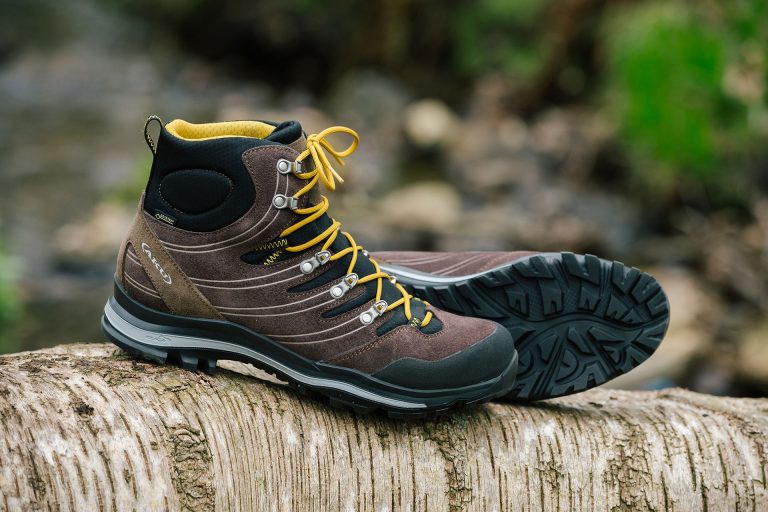
Shoes may be the current 'in thing' but there's plenty of scope to simply buy a modern, lightweight boot that slashes several hundred grammes off the weight of a conventional walking boot but still gives reassuring ankle protection.

Most top footwear brands now have lighter options in their ranges. The weight savings come from using lighter components and materials throughout the boot. That could mean a thinner sole unit, a carbon-fibre or moulded shank, thinner leather or fabric uppers, lighter lace hardware and, mostly likely, a combination of all the above.

A higher ankle cuff won't necessarily give more stability - that's down to the overall design and the heel cup in particular - but it will protect your ankle from scrapes on say, scree slopes and boulder fields as well as making it less likely that stones will work their way into the interior of your footwear.

For an idea of what's possible, take a look at Brasher's Supalite range which has taken the standard walking boot and massively reduced its weight with impressive results.

Top tip Fabric boots aren't always lighter than leather, most use large suede panels, so don't assume lightweight boots means fabric boots by default..


Approach Shoes

Approach shoes were originally aimed at climbers wanting something light and capable for walking in to their routes and some are still built that way with sticky soles, rubber rands and a close fit. Most though have metamorphosed into general outdoor and walking shoes.

There's more detailed information in our Buyer's Guide to Outdoor Shoes but shoes seem to have borrowed both from boots and running shoes. That means you may well get a running shoe-type upper and heel counter, but coupled to a soul unit that's more like a lightweight boot's and generally stiffer than a running shoe.

They make a good compromise between a lightweight boot and a trail-running shoe, and most, while too clumpy and high for proper running, do make decent walking shoes thanks to the extra stiffness and cushioning from taller mid-sole units.

We've found sole units with a distinctly flared heel give the best stability on rough ground, with narrow-heeled soles feeling distinctly iffy. Many feature waterproof breathable linings which are a boon in damp conditions, but may make your feet too hot in warmer weather. Fit needs to be snug and supportive. If your foot can move around in the shoe, it'll feel loose and unstable underfoot, so look for a slick lacing system that you can adjust easily to suit your foot.

Some shoes are also available in 'Mid' versions which can make a good halfway house between a boot and a shoe, if you're wary of low ankle cuffs.

Top tip Many approach shoes have quite shallow tread on the soles. That's fine on dry and rocky terrain, but can mean less grip than you'd like on damp, soft ground so check carefully.


Trail Running Shoes

We'd draw a distinction between trail-running and even fell shoes and more general approach shoes. Companies like Inov8 are producing shoes which, although primarily designed for running, also make good lightweight walking footwear.

Trail running shoes tend to have more underfoot cushioning than pure fell runners, but are still low enough to the ground to give some of the advantages of fell-running shoes - fell runners tend to be too minimalist for more general use with great underfoot grip and stability but very little cushioning or support.

Trail runners often make great warm weather options because they generally use fabric and mesh uppers with no waterproof membrane to keep the sweat in. Of course that's a double-edged sword as water can also get in from the outside.,ore easily.

Look for a close, glove-like fit, toe and heel reinforcement to deal with rock abrasion damage, low but grippy soles. Running shoes are built lighter and flexier to allow your foot to move more easily, but the pay-off is reduced durability compared to an approach shoe or boot and, for some, more localised foot fatigue at the end of a long walk, until your feet adapt anyway.

The pluses are a combination of great grip and nimbleness underfoot.

Top tip Most trail-running shoes use EVA for cushioning. This works well when new, but tends to compress and lose its spring with use. It's also vulnerable to abrasion damage, so expect to change trail runners more than you would, say, approach shoes.


Sandals And Hybrids

Yep, you may be shaking your head, but it's perfectly possibly to walk on mountain terrain wearing well-designed sandals or hybrids, though it is something of a minority trait.

Obvious advantages are ventilation in hot weather and lightness. Downsides are that it's quite easy to bang your delicate toes in rocky areas and small stones can get into your sandal, though they're generally easy to remove as well.

The toe issue has been addressed with closed toe sandals, most notably by Keen. Generally we've found the most functional sandals tend to be those designed for running and sports. Check for a snug fit with lots of adjustability and make sure none of the buckles rub against your foot while walking.

If you intend to use them barefoot then an anti-microbial sole unit will be a bit step in avoiding pongs. It is possible to fit aftermarket footbed or orthotics in some sandals - Bite for example - but most have an integral footbed.

Top tip Looks for strategic padding on straps, but make sure stitching isn't likely to rub against your skin.


More Help And Advice

This article should have given you some basic pointers. The good news is that there's a load more advice on OUTDOORSmagic:

Ask on the gear forum about general issues or specific items.

Check the member reviews section for user experiences of kit.

See OM editorial reviews on the front of the site for our impressions.

Ask Richard Gear if you have a specific question you need answering.


Buyers guides in association with eVent Fabrics
Bookmark thisPrinter friendly version
Want to send this article to a friend? Please join here
 

Discuss this article, 1 of 88 messages, read more:
alex Popescu 
Posted: 26/04/07 11:03:36 36
Hi everybody

I am planning a couple of challenge long routes, Welsh 3000s and Cullins, and I wonder if anybody has any advice on light footwear suitable for scrambling, fast moving and good ankle support.

Some friends suggested fell running shoes. I am not a fell runner and I wonder how suitable this type of shoes are for scrambling.

Any ideas please? I hate the idea of having to do these routes in my B2 LaSportiva which are fantastic for scrambling, but too heavy for fast moving.

Many thanks
alex

Read more...
Read member reviews:
Approach Shoes (227 products)
Sandals (97 products)
Trail Running Shoes (40 products)
Related articles:
New Stuff From Inov8
Lightweight footwear brand has more innovations up its sleeve.
Gearblog - Crossover And Proud Of It!
The outdoor industry's dirty cross-dressing secrets revealed...
Berghaus Phobic Stable Endure - First Look
Lightweight, stable and grippy trail-running or lightweight walking shoe reviewed.
Haglöfs First With Adaptive Insoles
From spring '09 Haglöfs footwear will come with a high spec, mouldable insole as standard.
Salomon Exit Sport Tested
We check out the summer-friendly latest in a long line of Exit shoes.
Brasher Calusa XCR - First Look
Brasher goes multi-active with the new Calusa XCR shoe.
Berghaus Phobic Light - Quick Look
Quick take on Berghaus's water-hating off-road running shoe.
Inov8 Roclite 390 GTX - First Look
First take on what's probably the world's lightest Gore-Tex-lined boot from inov8.
New Shoes And Bags From Keen
Sandals sorted for winter plus new daysacs from US brand Keen.
Merrell Jam Approach Shoes Tested
An approach shoe for climbers on a tea break, and the steeper moments in the hills.
Brasher Levanto XCR Tested
We take a look at Brasher's contemporary trail shoe with a generous fit.
Salomon Elios Mid XCR Tested
We check out the mid-height version of Salomon's latest all terrain shoe.
New Swedish Footwear Brand Reaches UK
Swedish outdoor footwear manufacturers Icebug have been doing pretty well lately in their home country of Sweden, and now they're ready to make the hop across the North Sea ...
Shoes Go Soft Shell
Just when you thought you'd just about worked out what soft shell is, Salomon come along with erm, soft shell shoes. What the heck, here they are anyway...
Buyers' Guide - Outdoor Shoes
Everything you need to know about trail shoes, approach shoes, walking shoes, festering shoes and, well, shoes really...
Funky Hybrid Takes Root In UK
Straight out of the US is a new brand called Keen, they reckon they're the fastest growing footwear brand in the world, and we reckon they look great. See what you think...

Members Logon
Email:
Password:
forgot your
password?
Article search
Support our partners

Cotswolds

VOTE
What mapping sytems do you use (in addition to printed maps)
Mapping software (e.g. Anquet)
GPS
Both mapping software and GPS
Neither- just printed maps
Not even printed maps

 Join Now ^ Top of Page
About OUTDOORSmagic
- About Us
- Privacy Policy
- Terms and Conditions

Subscribe to OUTDOORSMAGIC RSS news feed.
Contact Us
- Support
- Advertise with us
- FAQ
- Retailers: free site review
Affiliates
- Take our news for free
- RSS Feed
Magicalia Digital Publishing
Cycling
- BIKEmagic
- RoadCyclingUK
- SheCycles
- LondonCycleSport
- Visordown
- ProTourNews
Outdoors
- OUTDOORSmagic
- FISHINGmagic
- GOLFmagic
- TheMainSail
Lifestyle
- ThinkBaby
- Gardening.co.uk
- AVReview
- ThinkCamera
Hobbies
- ModelFlying
- MilitaryModelling
- ModelBoats
- GetWoodWorking

- Full Portfolio
© 1999-2008 Magicalia Ltd.